Onward from 2020
“I have to agree that COVID is making it so hard for everyone to do their daily activities.
I, also, have to agree that Professor Mac has been one of the best Professors I have had while going to College/University. The fact that he was always checking in on us and making sure we stayed safe and reminding us of the weekly assignments, was very nice to have. He was very understanding if we turned in a late assignment, as long as we communicated that with him (which is the right thing to do). The activities you picked are awesome choices because they were both fun to do and at the same time very rewarding.”
LBSU-302, Mar. 2020 – Week 8 Feedback
I have now completed my tenth year teaching liberal arts at the University Level. I have taught as an instructor in academia itself for twelve years and as a lifelong learner, have refined my teaching methods and believe in these six basic principles.
SIX PRINCIPLES OF MY INSTRUCTION
RESPECT: A faculty member must always respect their students and the time and money they invested to to take their course. Faculty instructors may teach 30+ students in one course or teach two courses at a time and must make active time to address each student in their written comments. This is also a part of the words “engagement” to give back feedback and “accessibility” to be an active and accessible professor to the students. Respect should be mutual in a course room as students should be able to analyze, interpret, and even argue, without the need for negative comments in a classroom discussion. Respect is a large part of an active academic classroom and a first rule for the engaged faculty member.
ENGAGEMENT: This is not just student engagement but rather the engagement of the faculty member, to be actively engaged in their professional field of study from researching and reading and staying active in their field. The most successfully engaged faculty members are the ones who are most interested in the future development of study in their field. The faculty member must be engaged with their students as well in the classroom. Responding to students in a 48hr-turnaround window.
CAPABILITY: I believe in the capability of every student to be an active participant in the course. While it is up to the instructor to give feedback so that the student understands the course requirements, A student has invested their time money, and energy into taking a course. Therefore, they should not need to be pushed to do their own coursework or constantly reminded to complete given assignments. An instructor should act as a mentor and guide, but it is up to the capable student who has invested so much into taking the classes to complete their own coursework without reminders. It is their job as a student to take on these responsibilities.
ACCESSIBILITY: As an online instructor for the last ten years, the distance education student must have multiple ways to connect with the teacher as well as multiple ways to engage in their own learning via smartphone, desktop, and smart devices. I always give students multiple avenues of communication. An instructor must also be an active member of the student online discussions as well as be available via zoom, email, and phone. An active accessible instructor helps the students in an online classroom feel more connected with the material as well as feeling supported by their instructor.
TECHNOLOGY: As an online-based instructor at the University level for the last ten years I have been able to see the advancements that have been made compared to when I took my first online course in 2003. I feel this is the key to my educational instructor philosophy, it is a part of what I do as a distance educational instructor. With 20+ experience in learning management systems I have seen the changes that have been made over learning management systems having worked actively with Blackboard, Canvas, Moodle, Desire2Learn, and Angel as a student and as an instructor. Both my master’s and Doctorate courses were online and as a former online student, I know how to actively engage with the technology students as well as those who are less connected with their technology but wish to take distance education courses to learn as they go. As a lifelong learner, I am always interested in advancing my knowledge and technological understanding. That starts with building and designing elements and curriculum in my own course and creating technological elements to aid students in their active learning.
INSTRUCTION: I am a professional librarian as well as an online educator who has learned to instruct students, but that starting basis as a researcher and librarian is an active part of my instruction. I guide students in finding correct sources and academic research elements as an academic reference librarian and now ten years as a Liberal Arts University instructor. I am also both visual and very technical, having perfected my understanding of American Psychological Association formatting first in 6th edition APA formatting and now in 7th edition APA formatting. I have taught online as an academic APA coach in tutor portals like Wyzant, to now teaching APA in the university classroom and expect the same professional standards in all my students. I expect my students to follow APA rules in their discussions and papers to prepare them for future learning in their academic undergraduate and graduate writing.
Teacher Instruction courses
Information Literacy (Nov 2022)
Learning Canvas (Jan 2023)
Foundations of Learning Management Systems (Nov 2022)
The future of workplace learning (Nov 2022)
Cultivating a Growth Mindset (Nov 2022)
Park University PDL750- Canvas Training for Adjuncts (Oct 2017)
Brandman University Adjunct Instruction (July 2013)
_______________________________________
Why I teach
As an instructor, I encourage my students to pursue lifelong learning and prepare them for research beyond the classroom. Through my lectures, I teach my students how to use various academic tools and incorporate these tools into their work to become better researchers. My goal is to instruct students in research abilities that will assist them even outside the classroom in their chosen fields and workplaces.
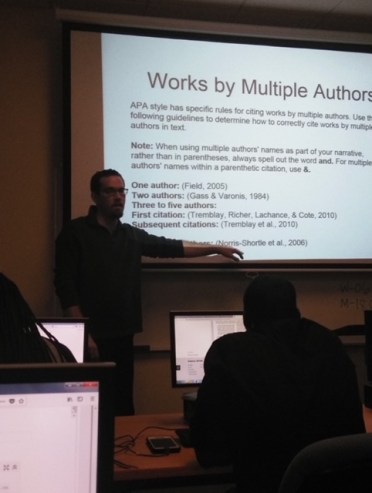 Teaching LBSU 302 at Antelope Valley, CA Location in 2018.
Collaborative Journey
“The secret in education lies in respecting the student” – Ralph Waldo Emerson
Understanding the needs of students and the obstacles they face in their life is imperative in assisting them with their success. To ensure academic success there are various factors that must be taken into consideration. Dedication is key. My dedication is to improve student learning by bringing innovation through teaching with andragogy philosophy and commitment. We are growing together on a mutual path toward continual higher education, seeking and finding the answers together. I’ve had students from all walks of life and there’s one common denominator, their desire to improve their lives and to seek out information. This is what drives me. This is why I became a librarian, to be able to supply the answers to the most challenging questions and to ease the fears and insecurities that students inevitably face on their journey to enlightenment and attaining their personal goals.
In online classrooms, I make it my mission to bring the experience of a traditional course to the online environment. This pursuit was the subject of my dissertation for my Doctorate in Education. This is my ongoing goal, to continuously bridge the gap that exists between brick-and-mortar courses and online courses. Developing their education through strong leadership has been my top priority and has led me to further study as I finish my own degree. My students have many factors in their lives that can have a direct effect on their education, they are mothers, fathers, parents, husbands, and wives. It is my job as a librarian and instructor, to help them navigate through life challenges by understanding their needs, which is understanding and being an academic advocate, advisor, and instructor.
My Purpose as an Instructor
By starting in the professional field of librarianship, I have been able to incorporate Library Science studies into my teaching ability. This has grown into teaching Academic Integrity, APA instruction, Information Literacy & Liberal Arts foundation courses and classes in student success.
Framework for Information Literacy
As a librarian and information literacy instructor, this written framework by the ACRL is an active part of my instruction in academia.
Framework for Information Literacy in Higher Education- ACRL 2015 – https://www.ala.org/acrl/sites/ala.org.acrl/files/content/issues/infolit/framework1.pdf
Teaching Style
My teaching style is to act as a guide and facilitator, to lead my students through their coursework, by helping them along the way. Every student that enters my classroom has a unique learning style that works for them, too which I learn to adapt to throughout the semester. Dictating a lecture will not instill or encourage growth. But keeping an open mind and listening to my students will. Using this style I continue to see real progress that is measurable by course completion. This measurable progress is easily found within the bulleted research notes required in assignments, their updated writing styles, corrections in APA formatting, the type of emails they send back to me, and reflection in their class blogs and discussion boards. As a mentor and instructor, I encourage communication with them throughout the week. I am always open to my students and welcome questions, as many students might have the same question.
My teaching style incorporates diversity while implementing different teaching methodologies and techniques. I am a very visual instructor and while teaching online and hybrid classes, I feel it is necessary to include a step by step visual processes students can easily follow. I also let my students pick the topic they are interested in through the research process to encourage active engagement. I am an instructor that is actively engaged in his student’s academic well-being, which increases their chances for academic success. Students make connections through their work with the resources I provide each week.
As an instructor, I have designed informational literacy materials and curriculum for student learning, in the 2-year and 4-year levels in higher education. My background as a historian, technologist, and librarian has come into play while designing and building course materials for the students I teach. As a visual artist, I also incorporate visual materials into my instruction.
As a hybrid instructor, I also try to incorporate customized responses to writing assignments based on the other work accomplished by the student. While this process does take longer in grading it pays off in their understanding of the course materials.
Teaching Style – Visual Instruction
As a visual learner myself as well as a millennial I do understand the need for visual aides to assist with instructions. This can be done through infographics and visual graphics within the online course room.
Understanding Diversity
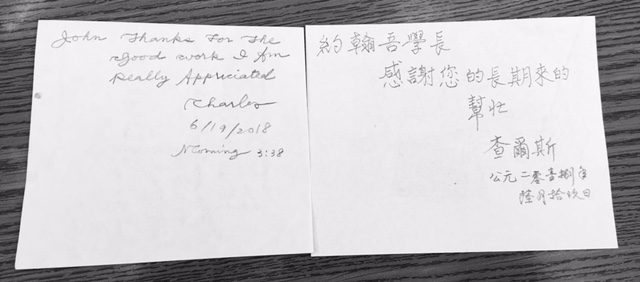
At both the community college and university levels, I have helped many individuals in underserved populations. I connect with my students on many different levels. As a white male in an interracial marriage of 13 years with three mixed kids, I am a parent and a father. I have been a working student and know the difficulties of raising a family, working, and going to school at the same time. I know how to connect with working parents who are starting or continuing their education. I also know the struggle of many middle-aged students coming back to their education and facing difficulties with new technology challenges since their time in college. As I reflect on my own personal and professional journey with academia, as an underprivileged male, and by this, I’m referring to an extremely humble upbringing, my world did not start to have a deeper meaning until I started my own academic journey. It is from this experience I was introduced to a plethora of students, teachers, and faculty who were all committed to the same goal, to assist us as students to succeed. It was through academia I was free to immerse myself, learn, understand, and empathize with others who come from vast backgrounds. From religion, sexual identity, and language barriers, in the community, we were all students and had the same goal, to succeed.
Working for over 10 years in a California Community College has given me further insight into the understanding of the need for campus diversity while participating in shared governance and attending workshops to gain a better knowledge of the various socioeconomic backgrounds of students and representative faculty for these groups and the key factors that impact student success. One of my many goals as an instructor is to help students can achieve their ultimate goals, no matter what their socioeconomic background may be. All students come to college to further their careers and personal goals, and it is my job as an educator to assist them in this endeavor. I have taken many classes in diversity for professional development and even a diversity class during my Master’s in Library & Information Science, LIBR 276 – Library Services to Diverse Communities during the Summer 2011 semester. I also served on the EEO & Diversity shared governance committee for Barstow College from 2014-2016.
Diversity Training
Adult Mental Health First Aid Training (Dec 2023)
Unconscious Bias – Linkedin Learning (Oct 2023)
Diversity, Inclusion, and Belonging (May 2023)
Driving Change and Anti-Racism – Linkedin Learning (Dec 2022)
Leading Diverse Teams and Organizations – Coursera – University of Michigan (Mar 2022)
Influencers
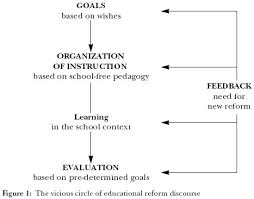 Much of my influence in instruction has come from Adult Educator Malcolm Knowles (1913-1997), and his work with Andragogy, business theorist Chris Argyris (1923-2013), who worked on exploring the effects of organizational change, and Robert Greenleaf (1904-1990) whos’ work with servant leadership has helped me to be a better instructor and better librarian, focusing on serving students in a “student first” mentality. I am also interested in the work of B.F. Skinner (1904-1990) as well in looking at the art and science of learning.
I recently took a course on curriculum through Coursera and learned about Ralph Tyler (1902-1994). I have started reading Basic Principles of Curriculum and Instruction (1949).
This picture represents the Curriculum organization model by Ralph Tyler.
How do I measure my effectiveness as an instructor?
I am fortunate that the institutions I have worked for have provided instructor feedback through student evaluations of my performance. While lecturing I can also self-evaluate my work based on the level of work returned to me by the students. The level and quality of my lectures are continuously enhanced based on the student questions I receive each week.
Pre and Post assessment tests in my class let me know how students have improved in my class and I can watch them walk out of my class knowing they have learned how to effectively research like an academic for their next course. They have acquired a new body of knowledge that will help them not only in their future courses but through their career. After passing my class students can write several different types of academic papers and have been taught how to academically cite information. With this information, I have advanced my students to the next stage of their academic journey.
I am grateful for the feedback from the students a semester or so later, thanking me for the lessons that they have learned and later applied in their lives on multiple levels. These testimonies validate my pedagogical philosophy and related ideas for educating students in a global community where they can become agents of transformative change, not only for themselves but also for the community at large.
Courses I would love to teach
I am interested in expanding my love of Liberal Arts and technology as I incorporate these subjects into the materials I teach.
My Future as an Instructor
In conclusion, my goal as a teacher is to instill a passion for education in the hopes of building lifelong learners. Providing my students with the right support, encouragement, and environment to make their experience on campus and in my class, a positive one is my ultimate goal.
I’m a forward-thinking instructor and always looking to update my general practices. As new technology comes out, I like to revamp my instruction to match the changes students are undergoing. I like to evaluate the bigger picture of adult and distance education and make changes as I continue to grow in my lifelong learning.
I look forward to future teaching and library opportunities and being able to share my abilities with my future employers in Higher Education.

 John Macomber